

Publish date: 16h 45m ago
Six of the ten most-searched Halloween costumes in the United States in 2025 came from a single Netflix film that was already four months old.
Google’s Frightgeist costume data, reported by FOX Local on October 15, 2025, ranked Rumi, Zoey, Mira, Jinu and Baby Saja from "KPop Demon Hunters" first through fifth, with the film’s tiger eighth. The film had premiered on Netflix on June 20, according to Variety.
That gap between a premiere and a peak is the basic shape of cosplay demand. Interest in a character does not arrive on release day and fade; it gathers around dates that fans can see coming, from a season’s first episode to a convention weekend to October 31.
A premiere starts a clock
The "KPop Demon Hunters" example is useful because the calendar is visible. A film arrives in June, becomes what Variety described in August 2025 as Netflix’s most-watched movie ever with 236 million views, and by October its characters dominate the costume searches.
Halloween is a fixed deadline, so it compresses the lag into a predictable window. Game characters show up in the same list, including the Chicken Jockey from Minecraft and the Nurse from Silent Hill, and each has its own release history. Not every character has a holiday attached, though. Most cosplay demand has no holiday attached, and relies on the other two calendars: the broadcast schedule and the convention circuit.
Anime seasons give fans a reason to return every quarter
Anime is released in quarterly seasons, running from January, April, July and October, and new series usually premiere within the first two weeks of a season, according to the German outlet Mein-MMO’s explainer on how the year is divided. A typical run of about 12 or 13 episodes fills most of a season.
For fans that structure means a steady supply of new characters on a fixed rhythm, rather than one annual burst. A series that finishes in March is replaced by another in April, and attention moves with it.
The calendars also overlap. The autumn season opens in October, the same month as Halloween, so fans are choosing costumes while a fresh set of characters is airing for the first time. The July season opens during the summer convention months. Those collisions are a plausible high season for the hobby, though no public data measures them.
Conventions are where the interest becomes visible
The convention calendar is the part with hard numbers. Anime Expo in Los Angeles reported more than 410,000 turnstile attendees for its four-day 2025 edition, with visitors from over 65 countries, in a release from its organizer. That is an organizer-reported figure and has not been independently audited.
In Tokyo, Comiket runs twice a year. Anime News Network reported about 250,000 attendees over two days at the August 2025 edition, around 50,000 fewer than the roughly 300,000 of the December 2024 edition. The outlet attributed part of the gap to a loss of exhibition space, since three halls at Tokyo Big Sight were closed for renovation, so the drop is not a clean read on interest.
The same table gives the recent run. Comiket drew roughly 270,000 in December 2023, 260,000 in August 2024, 300,000 in December 2024 and 250,000 in August 2025. Comparing each December edition with the August one that followed shows the winter event ahead both times, by about 10,000 in 2024 and 50,000 in 2025, though venue limits muddy the second comparison, and the first rests on rounded counts.
Both events work as deadlines. Fans and creators who want to be part of a convention weekend prepare ahead of it, and the weeks around it are when photos, previews and discussion cluster. That is common knowledge in the hobby, though it is not a measured figure.
What the data does not show
No public dataset links release dates to sales of cosplay content on any subscription platform. Search interest for costumes, attendance at conventions and release schedules are all real, but they measure fans in general, not buyers of a particular creator’s work.
The platform-level numbers are broad. OnlyGuider estimated global OnlyFans revenue at $7.2 billion in 2025, up 9%, according to FOX 4. In OnlyGuider’s city data, Xataka Mexico reported that Hong Kong, Shanghai, Nagoya and Tokyo posted growth of 27% to 30% in 2025, a range the outlet gave without breaking it out by city. Those figures say nothing about cosplay specifically.
The reasonable inference, which is an inference and not a finding, is that creators who work in this area plan around the same dates their audience does. A creator who posts a character the week a season opens is meeting an audience that is already looking.
How a fan can use the calendar
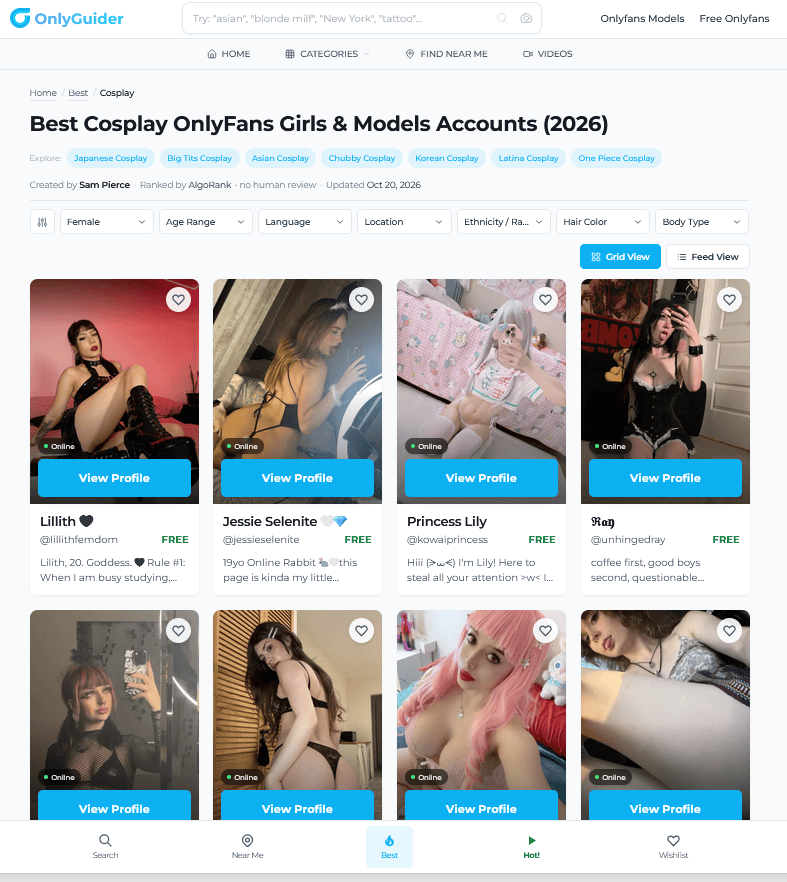
For fans the practical lesson is timing. A directory’s listing of cosplay girls is a starting point, but the better signal of whether a creator is current is simply what they posted this month and whether it matches what is airing or releasing.
Release dates are published well in advance, and so are convention schedules. A fan who checks both can tell when a character is likely to be popular, and which creators have already moved on to the next one.
Google’s 2026 costume rankings will show which of this year’s releases made the leap from screen to wardrobe. The calendar suggests the answer was settled months before October.